Showing posts with label Mindlab. Show all posts

Sunday, 1 April 2018

It all Starts Now. Key Change in my Professional Practice.


Coming to the end of my Mindlab journey is bittersweet in many ways. I feel a sense of achievement but also know that this is where I really take what has been learned and continue to grow from here.

What:
There are many things that have stood out over this learning journey, with a culmination of many changes impacting my professional practice, but possibly one of the biggest shifts for me has been the way I view and act out my role as a facilitator of teaching and learning in the classroom. So, (typical to me!) I have chosen to evaluate that change in relation to a combination of one element from the Hack Education (Parsons, Lynch, Han & Thorn. 2017) research- Future Focus, with one of the Ministry of Education (nd) Standards for the Teaching Profession- Learning Focused Culture.

Elaboration of the Learning Focused Culture Standard. Ministry of Education (nd).
Now what: evaluate the identified change
When teachers, or other professionals, critically evaluate their practice the use of a framework can be an effective tool to help identify and facilitate further change. The Cycle of Experiential Learning, recommended by Osterman and Kottkamp (2015, p.70), is what I will use during this evaluation. It is important to note that this process was not as neat or as orderly as it is presented here 😊.

Experiential Cycle stageAnalysis of
My role as a facilitator of teaching and learning in the classroom.
Relation to
Future Focused concept and
Learning Focused Culture Teaching standard
Problem Identification:
What was the problem? What drove me to make the change?
In my classroom I had noticed through the introduction of the ITL research (2012) collaboration rubric that although my students were cooperative they were not be being collaborative. If there were no behaviour issues, students were speaking nicely, taking turns and being respectful I had thought they were being collaborative. I was deciding on roles for students to undertake during the learning process also.In order for quality and effective teaching and learning to take place students were behaving well but being quite passive recipients in their learning. Who was really owning learning? Was there much risk taking going on? Was diversity and the unique contribution all learners bring to the table, really being valued?
For learning to be sustainable and future focused students need to be agentic.
Observation and Analysis:
What data is gathered?
What insights did I gather about the problem that drove change?
Both myself and my awesome trusty colleague worked together to develop collaborative skills in PE and in Inquiry. We took this time to sit back, and once given tasks to students, observed what the students were doing. How were they being collaborative? How was driving the learning? What changes were being made and when? Who were the contributors? Who made decisions that moved learning forward? Who didn’t do these things? Why?
This was really insightful and through our observations, surveying students and other formative assessment methods we came to see that students found it very difficult to drive their own learning. They were very careful in not making ‘mistakes’ or putting themselves out there in from of their peers, they were hesitant in making their own way- which we believe is essential and at the heart of learning.
During this time as well it became really important to see the supportive and collegial role my colleague and I were providing for each other and undertaking also. Our collaboration was visible and tangible for our students to see.
The concept of preparing students for an unknown future and equipping them with the skills and experiences in which to be risk takers and to drive their own learning became more and more obvious through this stage. Were we really providing learning opportunities in which our students were able to flex their cognitive and skill building muscles? If we didn’t provide these opportunities we ran the risk of maintaining the status quo which we felt would be a disservice to our students.
Of huge concern for our students at this time because of their age group (12-13 yrs) was the idea that to be an effective learner is to be vulnerable- many of our students were just not ready for this and this needed to be carefully managed. In creating and maintaining a positive and safe environment for learning children need to feel safe- not just physically but also emotionally. This needed to be catered and planned for.
Abstract
Re conceptualisation:
What new learning theories or research provides useful background to implement change?
What other perspectives be relevant to consider?
During this time we researched and designed learning activities that focused on students developing skills in context. The focus of setting the purpose for learning, the ways in which we all could be effective learners became of paramount importance. We then handed over the decision making process to the students. We could see the integration of the skills, the interactions leading to risk taking, choice making and collaboration in our classes.An effective learning environment is one in which students are given the opportunity in which to be agentic. Together in our classrooms we were all learners- none of us had ever set up, planned or designed a web based television episode before. Students were reflective and able to identify their own next learning steps- ones that would be relevant and useful to them in the future. We were working with individual strengths but collaborating across classes, digitally. We were reaching out to our community and involving them in the process. We began to see a change in reluctance as students began to take over their learning.
Active Experimentation:
What new strategies or ideas you have tried to implement in your practice? What have you learnt from the change/ experience?
What did I learn? I learnt that I didn’t need to direct and take the lead in the classroom; my students were more than capable of doing that for themselves. I had to let the reins go but that it was definitely not a free for all situation. The time effort and structure put in at the start led to the students feeling safe enough to take risks and move their own learning forward. Researching and investigating, design thinking practices and students’ agency over this time period has allowed us to have the confidence to know what we are doing is not just based on a whim or the next faddy thing out in education.Our next learning step for our new group of students is to now work on establishing design thinking as a delivery method for student learning. We are building on agency, future focus, and creating problem solving, risk takers. All of which need to be fostered in an environment that has learning and growth at its heart. We have lots of opportunities to work with each child and grow their own strengths.
We hope that these skills and the experiences they have will equip them for their futures, and that these skills will be sustainable and relevant in these futures as they find and solve problems they may face.

What next:
I want to continue to grow my professional practice. I am really aware of the need to maintain critical reflection and ensure what is happening in the classroom will equip my students for their future and build their learning capacity. I know that I truly value collaborative teaching approaches and see that teacher collaboration is vital in the progression of my teaching and learning programmes. Essentially I have learned that I can not do the thinking for my students, that they have to be given the opportunity to solve their own problems and be the agents of their own learning. I will continue to embed ICT into all my learning but know that this is an area I can really look into more next. I have HEAPS to do! 
I will try my best to continue to grow and I will always be a learner.

References:

ITL Research. (2012). 21CLD Learning Activity Rubrics. Retrieved from https://education.microsoft.com/GetTrained/ITL-Research

Ministry of Education (nd). Our code, our standards. Retrieved from https://educationcouncil.org.nz/content/our-code-our-standards

Osterman, K. F., & Kottkamp, R. B. (2015). Reflective practice for educators : professional development to improve student learning.(2nd ed.) New York: Skyhorse Publishing.

Parsons, D., Lynch, J., Han, B., & Thorn, R. (2017). Hack Education: Crowd Sourcing the future of education in New Zealand. In Spaces and Pedagogy: New Zealand Tertiary Learning and Teaching Conference Proceedings 2017. Auckland, New Zealand: EPress.

Road sign Future [Digital image]. (2017). Retrieved April 2, 2018, from https://pixabay.com/en/roadsign-future-way-sucess-2570954/ 

Culturally Responsive Pedagogy.


Made with Word Cloud. https://www.wordclouds.com/ 
It could be said that being a culturally responsive teaching practitioner would be a given in modern New Zealand schools, but unfortunately, that isn't always the case. To me, being culturally responsive means you respect each child/student you work with as their own unique and able person. You believe in, accept and promote that child's culture and life experience as part of your diverse classroom community.  Gay (2001, p.106) defines culturally responsive pedagogy as “using the cultural characteristics, experiences and perspectives as conduits for effective teaching”. 

When I read this I had to stop and really think about the word "conduit". In fact, I needed to look this up to make sure I was on the right waka. A conduit is something that channels, connects or transmits something, so the idea is that for teaching to be effective for the students in your class, their culture needs to be acknowledged and affirmed. This was further punctuated when Irvine, in Teaching Tolerance (2010), stated that culturally responsive teaching is when a teacher takes a student's shared cultural knowledge and experience and makes appropriate linkages between what that student knows, does and understands with examples, comparisons and contrasts. Teachers are described as "cultural translators" or "cultural bridge makers". But to be those translators or bridge makers we need to be highly aware and sensitive to different cultures but also, not blanket students by their ethnicity either. Culture can be as unique and individual as our students themselves.

At the heart of effective teaching and culturally responsive practice as Bishop (Edtalks 2012) and Bishop, Berryman Cavanagh & Teddy (2009) states is relationships. What the teacher then does within their teaching practice and with the relationships, needs to promote and drive student learning and achievement AKA agentic teaching.  See further elaboration in the image below:
Bishop, Berryman Cavanagh & Teddy (p.1, 2009) 
Over the past few years, my school has been part of Ka Hikitia and most recently Kia Eke Panuku. This has been revolutionary in transforming not only culturally responsive practice within our school but most importantly the achievement and success of Māori students within our school. Disparities between Māori and non Māori were statistically insignificant in our last end of year report (in fact our Māori students frequently out performed non Māori in many areas). So while taking part of this programme, this vision- the challenge now is to maintain and grow upon this success- never being complacent with what we have done and continuing to promote achievement for all students.


So what:
Mauri is considered the life force, “a central place in informing Māori, how and why our lives take the forms they do” (Pohatu, 2011, p.1).
Mauri Moe has two levels: first level is inactive state which can be thought of as “being dead” and the second level is proactive potential which can be described as a “sleep” state.
This could be thought of before our school undertook part of the Ka Hikitia initiative. There were varying levels of cultural awareness and focus on Māori success.

Mauri Oho is the state of being proactive, being awaken from the Mauri Moe
Initial consultation undertaking in the process of committing and promoting Ka Hikitia within the leadership of our school. This then moved on to voluntary mentorship and shadow coaching for Kia Eke Panuku. Over three years our school had strategic goals and an aim for 100% of all staff to have been involved and gone through at least one cycle of coaching and evaluation. I'm sure it's been a 5 year process and the pre and post data speaks volumes for the success we have had as a school.

Mauri Ora is the state of being actively engaged
I wouldn't say we are here just yet (in fact we're a long way off). We need to maintain focus, and continue to grow in our own pedagogy and knowledge. Resting on our laurels would not be beneficial for our school, community or students.

Where to next:
Like I have stated above we have a long way to go and success as Māori is broader than the concept of academic success. I would like to see more links and connection with our local communities. There is a collective responsibility for the success of our ākonga and the more we can take the initial steps to branch outside our classroom walls and invite our community in and use the community classroom the better. In their study of culturally responsive pedagogy in primary science classroom,  Cowie, Otrel-Cass, Glynn & Kara (2011, p.4) recommended that teachers needed to be seen out in the community; "A person who is visible in the community is more likely to be respected as having a commitment to, or investment in, the community (he kanohi kitea)." As educating leaders we need to make those steps, reach out into the unknown, make the invisible, visible for the benefit of all our students.  The resourcing and connections in hands-on, real-life contexts can only serve to enhance the education of our students. We need to continue to grow our curriculum and the way in which we care for and teach our students, engaging and motivating them to succeed.
And finally, as teachers, we need to always look for a way to be cultural bridge-makers for all our students.

References:
Bishop, R., Berryman, M., Cavanagh, T. & Teddy, L. (2009).Te Kotahitanga: Addressing educational disparities facing Māori students in New Zealand. Teaching and Teacher Education, 25(5),734–742.

Cowie, B., Otrel-Cass, K., Glynn, T., & Kara, H.(2011).Culturally responsive pedagogy and assessment in primary science classrooms: Whakamana tamariki. Wellington: Teaching Learning Research Initiative. Retrieved from http://www.tlri.org.nz/sites/default/files/projects/9268_cowie-summaryreport.pdf

Edtalks.(2012, September 23). A culturally responsive pedagogy of relations. [video file].Retrieved from https://vimeo.com/49992994

Pohatu, T. W. (2011). Mauri - Rethinking human wellbeing. MAI Review, 3, 1-12. Retrieved from http://www.review.mai.ac.nz/index.php/MR/article/viewFile/380/680

Teaching Tolerance.( 2010, Jun 17).Introduction to Culturally Relevant Pedagogy.[video file]. Retrieved from https://www.youtube.com/watch?v=nGTVjJuRaZ8

Saturday, 31 March 2018

What a Twit! Social Media and its use in the Classroom.


I used to love social media on a personal level (probably a bit too much😜) but have continued to pull back from this way of communication more and more in response to some of the things I was seeing and experiencing online. The increased personal attacks (that I was witnessing), lack of regard for others and general bombardment of advertising made social media for me at times, an unpleasant experience.

BUT... on the flip side, I discovered this amazing world of professional learning communities and have gravitated along this road now.

Just like for me, our students need to learn how to negotiate and navigate this polarising world of social media. That is one of our key roles as educators; helping to prepare our students to become responsible digital citizens so that they can interact and use social media to its fullest whilst being aware of the dangers it can hold as well.

In this post, I want to discuss the impact and potential that can be unlocked through accessing social media platforms on a professional learning level, using Jay and Johnson's (2002) reflective model, and reflect on a positive and negative experience I have had in my own personal learning journey when interacting on Twitter.

Describe:
The professional social media platforms I mainly use are Pinterest (ohhhhh you vortex of time and space), Twitter, Facebook, Google+ community and VLN (Virtual Learning Network). Each provides something different and a way of connecting with other educators on a variety of levels.
Melhuish (2013) describes in her thesis the key principals of effective social learning; learning that is social positioned, co-constructed and one that allows students to have agency over and drive their own learning inquiries. The ways and degrees in which people interact and participate on social media also has an impact. Some are active drivers of learning and discussion whilst others prefer to watch and observe from the periphery. For me, I am more of an active watcher- I get a lot from this and enjoy seeing different views and opinions. I occasionally participate in Edchat or other twitter chats and will freely share ideas and thoughts on google +. I am very selective about what I choose to comment on for a variety of reasons: passion about topic, moderator control or 'tone' on the chat and of course, time.

Compare:
As I have become more confident I have broadened out and commented more and more on different social media platforms. Here I would like to discuss positive and negative aspects I can see when interacting on Twitter.

I only use Twitter as a way of following other educators or education topics. The majority of my twitter experiences have been really positive. I love following new people, especially leaders in their professions that I otherwise would NEVER get to interact with. Having interactions like this is really exciting and pushes my thinking forward. I LEARN so much, get new ideas and as stated above, get to choose what I learn about and how I interact with others. Most moderators are sensitive to their users during chats and can skillfully elicit thoughtful dialogue and challenge participants to think on deeper levels.
On the other hand, we need to be careful that we don't fall into a 'cliche' of thinking too and only sign up or interact in conversation that only reinforces our own ideas. When we challenge or question others it needs to be done in a sensitive way too. Context and tone can often be misconstrued outside of face to face interactions.
One US tweeter I used to follow was a gal who was very tech savvy and I was learning lots of her tweets. One day she posted about assessing creativity and how to go about this. For me, this was quite an arbitrary topic and something that perplexed me so I posted, why would you want to assess creativity? I received quite a bit of backlash from the question and didn't really know what to do after that. I withdrew from the conversation. And here was where the problem lay; two different education systems, with two very different philosophies about teaching and learning. I have been into some American schools and know SOME of the differences in our systems. Instead of addressing our differences and having a really good conversation about assessment and creativity I unfollowed her and didn't participate any further. Did I bite off my nose to spite my face?? Maybe? Were our worlds too far apart?? Maybe? Should I have stayed and expanded on my ideas and thinking further? Maybe?
I did what I did- but that has made me super aware of what I post and need for understanding and appreciation of where someone is coming from when they post. I also need to have the courage to share my ideas though, in a thoughtful and considerate manner too. BUT only on forum, tweets etc that I feel safe. You can't control what others are going to say to you.

Critical reflection:

So what have I learned and where to next?

  • As teachers, we need to share these experiences on social media with our students- both the positive and negative in the aims of keeping everyone safe. Social media provides such a rich and wonderful learning opportunity for students and for a teachers' professional development.
  • We need to be willing to have professional discussions without attacking- critique instead of criticising.
  • We also need to be aware of different perspectives and be aware of others experiences.
  • Social media can break down isolating barriers depending on how much you want to get involved in this form of interaction.  You can link to ideas and people that can push and challenge your thinking
  • Events that happen in real time serve as a source of rich learning material- something that social media does extremely well- just be careful of potentially 'surprising' things that may come up with un-viewed material too (when sharing with students).


References:
Jay, J.K. and Johnson, K.L. (2002) Capturing complexity: a typology of reflective practice for teacher
education.Teaching and Teacher Education, 18, 73-85.


Melhuish, K.(2013). Online social networking and its impact on New Zealand educators’ professional learning. Master Thesis. The University of Waikato. Retrieved on 05 May, 2015 from https://researchcommons.waikato.ac.nz/bitstream/handle/10289/8482/thesis.pdf?sequence=3&isAllowed=y

Ochoa, R. (2009, May 13). Twitter_Good_Bad [Digital image]. Retrieved April 1, 2018, from https://www.flickr.com/photos/rosauraochoa/3528880050

Saturday, 24 March 2018

Ummm... can I post this? Influence of Law and Ethics in Practice.


Digital and web-based communication platforms make it so easy to share learning with the whanau and caregivers of the students in our classes. What was once hidden can now be openly celebrated with the wider class community. But how can we keep everyone safe in a digital age and what are our responsibilities as educators to ensure safety for all?

As the exploration and use of digital technologies have evolved, so too has the need for clear guidelines as students, teachers and schools begin to encounter issues that had never occurred before. Online bullying, harmful use of digital images and poor online conduct, in general, highlight a need for digital citizenship practices and the development of laws and guidelines for all involved.

In New Zealand, teachers are governed by a Code of Ethics (Education Council, nd), legislation* and various local school-based policies which help provide and maintain effective and safe learning environments both on and offline. Dealing social/digital media and all the unknown complexities of this form of communication will create times where teachers are confronted with ethical dilemmas in which they need to deal with.

Feeney and Freeman, as quoted on the New Zealand Education Council website (nd) defines an ethical dilemma as "A situation an individual encounters in the workplace for which there is more than one possible solution, each carrying a strong moral justification. A dilemma requires a person to choose between two alternatives, each of which has some benefits but also some costs (Feeney and Freeman, 1999, p.24)."

The dilemma I want to focus on was an issue that occurred over 7 years ago. At the time, cyber-based bullying incidents were quite new and reflecting back now I can see just how much things we have evolved and changed in response to issues surrounding the misuse of these technologies. Using Rolfe, Freshwater and Jasper’s (2001) reflective model, I will discuss an issue that many teachers will have encountered - cyberbullying, but also look back on how as a profession and, in part, society has changed in response to the need to deal with this issue also.

What:
A student and parent came to school after hurtful and degrading comments were sent and posted digitally by another student in my class.

So what:
Students were spoken to separately. As this incident had happened outside of school and school hours there was an unspoken feeling it wasn’t a school issue but we wanted to deal with it anyway. The student who sent the messages lied and denied her actions, even after it was clear what had occurred (it was thoroughly investigated). A meeting was set up with the principal and unfortunately, the family lied about the student's role in the incident too. The dilemma was not just about the student who was hurt during this interaction but also about a perceived lack of awareness and responsibility in hurting someone else. It wasn’t just the student receiving the messages that was being harmed in this situation.

Now what:

Although there was nothing we could do further, the family was clearly made aware of what was going on and had the facts presented to them. The school could only clearly state the guidelines they expected from student behaviour. We didn’t have a school policy concerning this as it was quite new territory. And there were no further issues as the whanau ended up moving to a new town- which was a real shame.

Today, you could say there has been a shift in focus from dealing with incidents after the fact, towards educating students about preventing incidents from happening and how to be positive digital citizens. We now have school policies, the Education Act (1989), has been updated to reflect digital elements of education, other legislative acts have been brought in to ensure safety and awareness on the internet. In my classroom students are encouraged to think about their digital actions, in and out of school and are beginning to become more aware of the legalities involved in digital interactions. Programmes of work have been developed to help students and teachers navigate within this new learning territory. There has been a move from thinking about digital behaviour that occurs ‘outside of school as not being a schools problem. In fact, the Ministry of Education (2016. p27) states “Schools have a responsibility to act…” in such incidents.

What is evident is that school communities and whanau need to work in partnership so that our students are best equipped to be responsible digital citizens of tomorrow. What I most importantly learned from this incident was that we need to take care of  ALL our students, informing and helping them to make good decisions online and to think before they send or post content.


* Harmful Digital Communications Act, 2015. Netsafe.org (2016). Various amendments to the NZ Education Act, 1989, as stated in Ministry of Education (2015).

References:

Education Council New Zealand. (n.d.). Frequently Asked Questions. Retrieved March 24, 2018, from https://teachersandsocialmedia.co.nz/resources/frequently-asked-questions

Ministry of Education. (2015). Digital technology - Safe and responsible use in schools. Retrieved from http://www.education.govt.nz/assets/Documents/School/Managing-and-supporting-students/DigitalTechnologySafeAndResponsibleUseInSchs.pdf

Netsafe.org. (2016). THE HDC Act and Netsafe. Retrieved March 25, 2018, from https://www.netsafe.org.nz/hdc-act/

Rolfe, G., Freshwater, D., Jasper, M. (2001) Critical reflection in nursing and the helping professions: a user’s guide. Basingstoke: Palgrave Macmillan.

Wanted: Digital Citizens [Digital image]. (n.d.). Retrieved March 25, 2018, from https://digitaljlearning.org/blog/2016/04/19/teaching-responsibility-wild-west-cyberspace

Monday, 4 December 2017

Communities of Practice

Curious minds coming together for a shared purpose, to grow and extend their (and other's) learning, AKA Communities of Practice.

Well, that's my definition of this concept. Jean Lave and Etienne Wenger, a social anthropologist and an educational researcher and practitioner respectively, were the first to coin this term (Wenger Traynor, 2015).

Wenger (2002) highlights three key elements of a CoP


  • Joint enterprise: is a shared domain which is the “collectively developed understanding of what the community is about”. The topic of interest shared by the group. 
  • Mutual engagement: the members engage through interactions within the community, building mutual trust in the relationships. The shared activities and interactions members have concern the domain. 
  • Shared repertoire: is “the communal resources” that the community of practice produce (Wenger, 2000, p.229). Shared tools, language, and practices of the community etc.
I personally find being involved in CoP's important. Not just for the personal and group growth of knowledge and learning, but for the other aspects as well. Being involved in a mutually respectful team with people who have similar passions helps to motivate and drive the profession (or interest) forward. These sorts of organic groups are vital (in my opinion) for personal satisfaction and the challenge they can provide. There also seems to me, to be a vital element of choice within a CoP which makes the CoP seem more a more authentic group to participate in. The domain is not mandated by 'others' but driven by participants themselves to improve their 'practice'.

My main CoP would center around the Year 8 team members I work with, in my school. We are a very collaborative group and gain a lot from sharing our teaching and learning experiences together. We are led by a very capable leader who helps push and challenge us. We have a group vision based around doing the best we can for our students and who they are as people. Within this CoP and throughout our school other CoP's occur based on interest and need.
So how does teacher inquiry contribute and link learning in our CoP?
By interacting and endeavoring to learn, working together, sharing, researching and discussing we will construct new knowledge and understanding which should work towards improving our practice and the outcomes and benefits for our students.


Issues (or ideas for exploration) in my professional practice:
  • As a team, we are always looking for ways to authentically engage our students in their learning. To grow and foster their academic and social growth. 
  • Using digital learning tools in more creative ways. 
  • Continuing to develop more opportunities for students to create digital content instead of mainly consuming content. 
  • Using and applying higher levels of the SAMR model within classroom practices. 
  • Helping students understand that mistake and decision making, as well as forging their own learning pathways is a key element to their learning. 
  • Improving student autonomy and agency. (Probably a bit broader than the idea above). 
  • Developing programmes that employ more problem solving and 21st-century thinking skills for students to engage with.


After sifting through a multitude of ideas (and believe me there were MANY) I have narrowed my inquiry ideas down to the following:


1. How can Augmented Reality be used to enhance student learning and curiosity during inquiry?


2. Can design thinking processes be used to improve student autonomy and agency within the classroom? 


Each of these topics for inquiries can be used to grow the shared understanding and knowledge of our CoP and address some of the issues currently faced. Moving forward from this and applying Kotter's change model (Kotter, 1996), early adopters will also be keen to take on and use what has been found out to help make the technological changes that can help grow our CoP's teaching/knowledge repertoire. This, in turn, should help equip students with more if the 21st-century learning skills (Lichtman, 2013) and fulfill the expectations of the New Zealand Curriculum (Ministry of Education, 2007) that have been highlighted as being so important for students have and use in their futures. There will be both short and long term benefits.


What will we need to be aware of in a CoP?
  • Time limitations- teachers are busy people and making an inquiry a priority can be challenging. 
  • Researching and inquiring broadly (thanks lit review!). At times CoP's could be in danger of being 'blinkered' because those involved often think and act similarly, (Hodkinson and Hodkinson, 2004), we (or I) will need to stop and check in for academic rigor in the work done and the knowledge grown. 
  • Critiquing work, highlighting potential biases and expanding perspectives. 
References:

Hodkinson, P., & Hodkinson, H. (2004). A Constructive Critique of Communities of Practice: Moving Beyond Lave and Wenger. (Seminar Paper). Retrieved December 4, 2017, from Oval Research 2004 website: http://hdl.voced.edu.au/10707/18014

Knox, B. (2009, December 4).Cultivating Communities of Practice: Making Them Grow.[video file]. Retrieved from https://www.youtube.com/watch?v=lhMPRZnRFkk

Kotter, J. (1996). Leading Change. Boston, Mass.: Harvard Business Review Press.

Lichtman, G. (2013). What 60 Schools Can Tell Us About Teaching 21st Century Skills: Grant Lichtman at TEDxDenverTeachers [video file]. Retrieved from https://www.youtube.com/watch?v=UZEZTyxSl3g

Ministry of Education. (2007). The New Zealand Curriculum. Retrieved from http://nzcurriculum.tki.org.nz/

Puzzle [Digital Image]. (n.d.). Retrieved December 4, 2017, from https://www.cdc.gov/phcommunities/resourcekit/intro/cop_approach.html

Too Many Choices [Digital image]. (n.d.). Retrieved December 4, 2017, from http://awordywoman.com/1102/

Wenger, E. (2000). Communities of practice and social learning systems. Organization,7(2), 225-246.

Wenger-Trayner, E., & Wenger-Trayner, B. (2015). Introduction to communities of practice. Retrieved December 04, 2017, from http://wenger-trayner.com/introduction-to-communities-of-practice/

Monday, 20 November 2017

On My Own... My Reflective Practice

Reflective practice is probably something most teachers do innately. Stopping and changing tack in the middle of a lesson, responding in a different way to the behavioural needs of students or thinking back about what worked or didn't work in a lesson and what to do differently for next time. I personally couldn't imagine a time or place where some sort of reflection has not been used in my own practice to help make sense of a situation or to try to make the best learning outcomes for my students. 

But what makes reflection meaningful and pushes us further in our practice rather than just a quick glance back into our day?
Findlay (2008, p10) states 'Done well and effectively, reflective practice can be an enormously powerful tool to examine and transform practice." A question and a complication from this statement arises: what is effective reflection and how can it be managed by busy teachers for a real and meaningful, transformative effect? 

What I enjoyed and one of the main understandings I got from Findlay's (2008) paper was that one size doesn't fit all. How, and when, and why teachers reflect, and for what purpose and outcome, can all vary. As with most things, choosing and selecting the type of reflective model that best suits you at the time is what will be of most benefit. Being exposed to a range of models and identifying the benefits and drawbacks of each type of model could empower teachers to increase the complexity and depth of thinking they participate in. Thanks to Craig Lineham for finding this link about a range of reflective models. 

Another thing I found useful when thinking about reflective practice was the challenge involved in reflection; personal challenge that makes us identify our own biases and assumptions; challenge in going deeper and not just skimming the surface of our understanding; and challenge towards incorporating reflection actively in our practice in a way that works for each individual.

So in critically evaluating my reflective practice, I completed a quick survey (based on the following questions) to get the brain juices flowing.

How often do you reflect on your practice at the following levels? (Rapid, repair, review, research, re-theorising and reformulating).
The second question of the survey is adapted from Zeichner and Liston’s (cited in Finlay, 2008, p.4) five levels of reflection:
  • Rapid reflection - immediate, ongoing and automatic action by the teacher. 
  • Repair – in which a thoughtful teacher makes decisions to alter their behaviour in response to students’ cues. 
  • Review – when a teacher thinks about, discusses or writes about some element of their teaching. 
  • Research – when a teacher engages in more systematic and sustained thinking over time, perhaps by collecting data or reading research. 
  • Retheorizing and reformulating – the process by which a teacher critically examines their own practice and theories in the light of academic theories.”
Like many other teachers, I find it easy to reflect at the rapid, repair and review levels- I think that comes quite naturally. The question posed was what can help you reach a higher level of reflection?
I think, like with teacher inquiry, research and sustained thinking over time needs to have a clear focus or avenue of inquiry. What patterns keep occurring, what data can be produced? Actively working and finding a way to record and pursue reflective ideas can be challenging. Working through Mindlab and being 'made' to reflect and compare my reflections with current theory etc will be helpful towards achieving those higher levels of reflection and purposeful investigation into practice. Hopefully, this will become a habitual part of what I do...

How often do you reflect on your practice in the following ways? (conversation, journaling, tweeting etc)
I am probably more of an informal reflector. I personally get more from having conversations with colleagues or confidants about issues or things I am reflecting on and enjoy having someone provide prompting questions etc to make me think on a deeper level. From this, I can also identify that I am somewhat passive in my reflections; waiting for someone to prompt or question me is not challenging myself to ask those uncomfortable questions. I also don't particularly enjoy being asked uncomfortable questions and am not a person who can answer more probing questions straight away- I need time to process.I like to think and mull over ideas. In some ways I can be avoidant towards some trickier questions. So to make my reflections transformative and meaningful I probably need to ask and face those harder confronting questions.


I look forward to seeing the strategies and other ways teachers delve into the deeper levels of reflective practice.


References:
Finlay, L. (2008). Reflecting on reflective practice. PBPL. Retrieved from http://www.open.ac.uk/opencetl/files/opencetl/file/ecms/web-content/Finlay-%282008%29-Reflecting-on-reflective-practice-PBPL-paper-52.pdf 


Gross, S. (2003). It Sort of Makes you Stop and Think.[Cartoon]. Retrieved November 20, 2017, from https://www.art.com/products/p15063312757-sa-i6845266/sam-gross-it-sort-of-makes-you-stop-and-think-doesn-t-it-new-yorker-cartoon.htm

MindLab (2017). Evaluate your Reflective Practice – July 2017. Available from:https://docs.google.com/forms/d/e/1FAIpQLSee9-DSqP0CG293TIgL5lq7H3c2Nbh5QyBrejnfWg1M0FAGsA/viewanalytics

[Reflective Practice Image]. (n.d.). Retrieved November 20, 2017, from http://facilitationcourse.co.za/wp-content/uploads/2017/08/reflective-practice-collaboration-and-stakeholder-communication-4-638-1.jpg


Saturday, 28 October 2017

Teacher Inquiry and the end of the First Half of the Mindlab Course

Sixteen weeks have just flown by. Sixteen sessions with the team. Three and a half assignments complete (currently halfway through one right now).  And now, we're about to start the next part of the course online. This course has been challenging and inspiring, and I've really appreciated the deeper understanding I am developing as a teacher and a collaborator of educational outcomes. I'm looking forward to this next stage.

Last week for session 15 we looked at Inquiry; both teacher inquiry and student inquiry - the parallels between the two are so similar. For this blog though, I want to focus in on teacher inquiry. Why? Because it is something I have really struggled with. Teacher inquiry, to me, has felt arbitrary and another thing to load on top of already busy teachers. Not the best attitude I grant you but that is/was my honest feelings.

I am naturally am a learner. I like to find things out; think I'm quite a curious person, like to get the positive results out of my students and do the very best I can.  I  naturally inquire into things from my observations of my class and students and work from there. Isn't that what teaching is about? The thing that didn't quite connect to me was the whole paper trail of proof (wasn't that in the results, the student voice, the formative feedback, assessment and student work?) and the top-down approach I would feel during this process. Cynical yes, but write it down, tick it off, let's look at it again next year and go from there.
But to be honest, often I would blank out when it came to that time of year and really not know what I wanted to 'commit' to as an area of focus. There are so many needs. Fear of failing and not meeting the 'right' target or showing enough growth always paralysed me.

Luckily, I have an amazing appraiser who has been able to see through my cynicism and 'teaching baggage' to help me do what I need to do, while still encouraging and challenging me in my practice. So when I saw we were going to do Teacher Inquiry as part of the course I wasn't too sure where this was going to go and whether I would be interested. I was pleasantly surprised though and have had some big shifts in my thinking.

The Spiral of Inquiry.

Timperley, H., Kaser, L. & Halbert, J. (2014).

Our school's current teacher inquiry model that we use is also a spiral based model but for some reason, it didn't connect with me. Maybe I didn't understand it properly or was a bit too close minded to appreciate it.  BUT after reading and learning about the Spiral of Inquiry by Timperly, Kaser & Halbert (2014) I feel like I've had a bit of an epiphany. Not only am I seeing the possibility of using this model in my own practice but I am feeling like I'm getting the bigger picture of the whole Teacher Inquiry thing! 😇

Using the spiral of inquiry:

  •  Actively investigating in a teacher-led inquiry: "This requires a shift from student voice to developing learner agency, as the students help to identify and address issues in their learning environments. In the past it has often been adults who have decided what is right or wrong with learners, and what is good for them, without involving them in either identifying issues or developing solutions. Deciding what is going on for learners without their input lacks respect and is unlikely to be productive." Timperley, Kaser & Halbert, (2014.)
For this teacher-led inquiry to work, teachers must come at their inquiry with a mindset of curiosity. It allows teachers to suspend judgement and make changes based on evidence. What is happening and why? I love this!
  • Scanning: open yourself/school up to honest judgement. Terrifying but I'm getting to grips with this not as an element of criticism but of opportunity for growth. Okay, I am a still a huge bit terrified.

I like this spiral of inquiry more because of the deep connected, human element to it. The learner's at centre, the teacher as a learner, depth over surface. 

The guiding questions and boxes in the article (referenced below) are Excellent! 
Two key questions posed that stuck in my mind were: Is it acceptable for some learners to be pursuing important questions in depth while others are restricted to ‘covering’ the curriculum? Is it all right for some learners to experience challenging and engaging learning in one class while learners in the room next door are not? WOW !!Food for thought. Those are hard, challenging questions.

I haven't gone through the rest of the model but these are some of the things that have stuck and resonated with me. I'm looking forward to exploring my own teacher inquiry and general teacher inquiry through the second half of the Mindlab course in more depth over the next sixteen weeks or so.

References: 
Timperley, H., Kaser, L. & Halbert, J. (2014). A framework for transforming learning in schools: Innovation and the spiral of inquiry. Centre for Strategic Education. Retrieved from http://www.educationalleaders.govt.nz/content/download/74475/611763/file/Spiral%20of%20Inquiry%20Paper%20-%20Timperley%20Kaser%20Halbert.pdf

Sunday, 22 October 2017

Catch Up Time: Again! Lessons about Staying On-task through Design Thinking

Last week's Mindlab Session found us partnered up to delve into the how we were going to be able to keep focused and on task after the course changes from face to face learning to more online learning. Woah, okay - something big and looming and isolating... or does it have to be?

I really enjoyed working with my partner and we found out we had a lot of similarities. Both of us are focused on doing our best as learners but also concerned with how we were going to remain motivated and be successful in a more independent working environment.
We delved deeper into what was really going on and for me my main issues surround:
  • being emotionally invested in my learning; choosing a topic that really inspires and challenges me
  • continuing the collegial support and challenge I have already received and find stimulating
  • remaining focused, on-task and productive, delaying gratification, rewarding completed tasks etc
How to manage these challenges is something that concerns me but now that we have really gone into some depth to explore them I feel I am more ready to work through these productively.


What I loved about last week's session- as well as allowing time to raise and talk about these issues, was the creativity that came with designing a prototype to combat these concerns. I consider myself to be pretty imaginative and creative so designing 'Ye Cup o Success' for my partner was so much fun.


Its a little hard to see but here are our groups' design prototypes (most of them). This was really challenging to create something to address an abstract notion but we managed to do it- with a lot of imagination, symbolism and a requirement for the viewer to stretch their thinking.


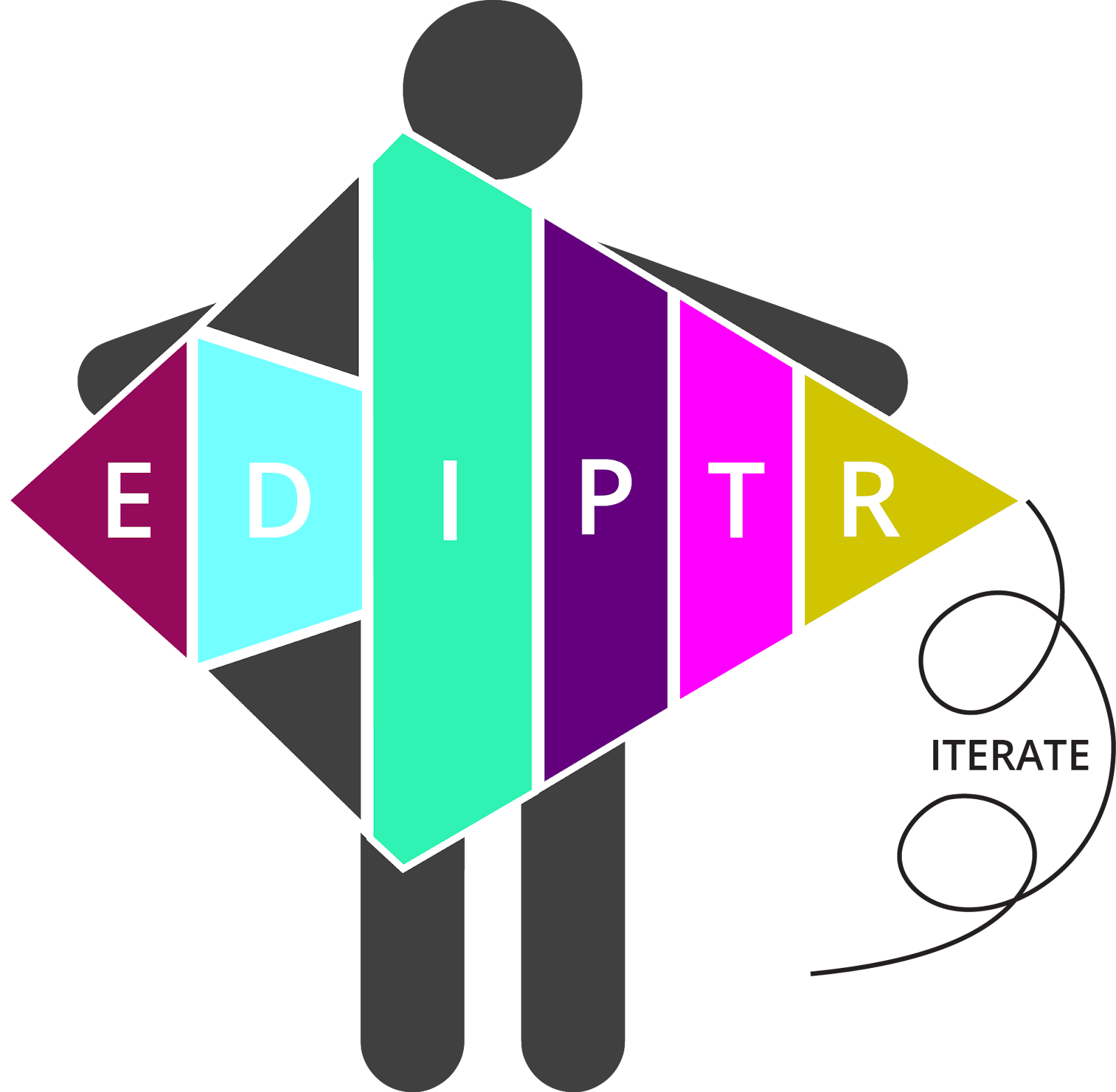
For this task, we used the Mindlab's Kite Design Model. It was a very structured and guided approach which I personally really liked. When sharing concerns or ideas, the listener really had to listen and interpret, what the speaker was saying. I think this is such an important skill and something our students (in fact all people) could benefit a LOT from developing more. But knowing how to listen, and having a real purpose for the listening is also important. Using the design model really helped to enable those skills. I will definitely be using something quite similar in my classroom in the future.


Design thinking by TMLU. The Mind Lab by Unitec Design Thinking Process + materials, which uses our 'kite' model: *Empathise *Define *Ideate *Prototype *Test *Reflect 


We were asked to reflect on the following question: 
How can design thinking be used to enhance students real-world problem-solving skills? 
  • The thing here for me is that students need to have authentic opportunities for applying real-world problem-solving skills in the first place. So this question arises in my mind- is it better to make up problems or create somewhat tenuous situations for students to solve or not to get students to do it at all? I think at least a contrived situation is better and exposes students to problem-solving situations, but also teachers perhaps need to allow students more opportnities to solve their own problems. Keep them local, keep them real, keep them relelvent. Do we always see those opportunities or do we rush in and solve problems for them before the students even realise they are able to solve them themselves.
  • After some authentic problems are identified- then yes ABSOLUTELY design thinking can provide a really structured and supportive framework to help students dig deeper into developing their problem solving ability. I love the empathetic aspect of the Mindlab's Kite design thinking model. The importance of listening to the problem and thinking of different ways to tackle the problem is really stressed in this model. 
  • IDEO's Human Centred Design resonates with me as well:
    • As you move through the human-centered design process, it doesn’t matter what you make, the materials you use, or how beautiful the result is, the goal is always to convey an idea, share it, and learn how to make it better
    • The focus is for design to get into the hands of the people who it will serve. Action based
    • Learn from failure- not knowing what the outcome will be- risk-taking
    • Empathise- put yourself in the shoes of the people you are designing for. Immerse yourself in that culture
    • Embrace ambiguity- by not knowing the answers, opening up to creativity and not 'racing' to be the 'first' 
    • Optimism- opening up to tackle those big problems. Embracing opportunities and believing that every problem is solvable
    • Iterate - do things over and over again to improve, create ideas etc
  • I think as human beings we can all develop ourselves through design thinking. Being humble and ready to change for the betterment of the whole world is a noble aspiration. 
  • We can and already do apply design thinking in our own teacher inquiries; for isn't this really just design thinking in action??
The Mindlab by Unitech Design. (nd). Unitech Design Thinking Process. Retrieved from: https://app.themindlab.com/course/release/1313-week-14-digital-design-thinking-in-the-classroom 
IDEO.org. (2015). The Field Guide to Human-Centered Design (1st ed.). Canada: IDEO.org. Retrieved from http://d1r3w4d5z5a88i.cloudfront.net/assets/guide/Field%20Guide%20to%20Human-Centered%20Design_IDEOorg_English-ee47a1ed4b91f3252115b83152828d7e.pdf 

Monday, 2 October 2017

Design Thinking in Education and a Student led TV programme

Well, it seems like I'm into fortnightly blogging. I need to try and get back into the habit of blogging each week.
I will get back into blogging each week...
I will!

There have been HEAPS that we've covered over the past few weeks and I am pleased to say that a lot of what we have been doing in our Mindlab sessions have come in really handy for my own practice and set up for our HTV.
SO over the past month my colleague Holly and I have been trying to make some big changes in our classrooms by applying the innovation we proposed in August for our first digital assignment. The gist of the proposal was to have the students in our classes combine, to organise and produce their own web-based television programme. No this probably not a new innovation in the wider world of education (think newspapers, radio stations, prior versions of student-led TV) but something new for us was the amount of real collaboration, problem-solving and decision-making skills we have handed over to our students. Are we going to be successful? The kids certainly think so... so watch this space! Exciting stuff.

Last week in class we looked at Agile and Lean concepts in the world of education. There are still many concepts I  have to get my head around but there were also many ideas I immediately liked and want to explore further.

Agile and Lean Education
With its foundations in manufacturing and IT industries, agile and lean methodologies can be applied to education. Agile methods change up the traditional command and follow processes that can be found in many sectors of life. Kropp, Meier, Mateescu & Zahn (2014) state, "Such methods emphasize the importance of highly interactive self-organising teams and close collaboration of all stakeholders, as well as values like courage, openness and respect." Linking in the importance of 21st Century skills for learning, agile methods mesh extremely well towards preparing our students for that unknown future.

The Agile Manifesto  ( http://agilemanifesto.org/) highlighted the following:

  • Individual and actions over processes and tools
  • Working software over comprehensive documentation
  • Customer collaboration over contract negotiation
  • Responding to change over following a plan
We are asked to apply this to education and created
  • Learners over prescribed curriculum
  • Authentic and contextualised learning over worksheets and textbooks
  • Collaborative relationships over didactic transmission
  • Teachable moments over lesson plans
There were many really great adaptations of this from our group as well.


Lean 
According to Barney and Kirby (2004), educators can learn from lean production methods the importance of empowering teachers by training them to problem solve and then expect them to be self-reflective and to continuously improve their practice. The thing I liked about both was how easily I can pull in these ideas into my own classroom. we looked at Kanban, also standup meetings and self-organising groups. I immediately used all three of these ideas in my classroom the very next day and have been doing my own research into some of the practices and tools used in Agile schools using Lean methods too.  

Positives and questions I have about Design thinking in Ed:
+  great to see a methodology that focuses on the implementation and use of 21st C skills as well as values. 
Educational settings could do with getting rid of Muda- bureaucracy is very high. Limiting systems or streamlining could be great. There are so many competing priorities in Education. 
Self-directed and driven students
? We are not pumping out consumer-driven products- or are we? This goes to the heart of the purpose of education.
? What are the downsides or negatives of using this approach. It can't be without a cost perhaps?
? How does this type of self-directed and collaborative approach apply to all our students? Esp ones with learning and behavioural needs?
? What is the research behind this approach in an educational field? Has it been tested? Are the outcomes noticeably different?


Steve Peha
Steve Peha is an American educator and IT manager. I watched a youtube link given to a group of Microsoft exec ( I think) given by Steve Peha in 2011. I found it really interesting and recorded some ideas and notes as follows.
  • Agile Manifesto
  • Technology has not changed educational outcomes.
  • Roland Fryer discovered that educational incentive pay did not have any positive outcomes on student achievement
  • "How can we run a school with no method for improvement?"
  • Waterfall methodologies have failed- dumping kids off to the next group of teachers/schools etc after 'we' have done with them. Is the right way to think about our students? There's no collective ownership and protection of these students education.
  • Applying software methods to help students and schools raise achievement.
  • Chester Finn- National Journal of Educational Experts blog
  • Agile (Scrum, Kanban, lean)- huge gauge on productivity, -use the humanistic values in this system. - higher quality work. 
  • Use the culture of agile to improve
  • Right shifting ( not in this video but something else I've picked up).


Barney, H. & Kirby, S.N. (2004). Toyota Production System/Lean Manufacturing. In B. Stecher and S.N. Kirby (Eds.), Organizational Improvement and Accountability Lessons for Education From Other Sectors (pp. 35-50). Santa Monica, CA: Rand Corporation.

Kropp, M., Meier, A., Mateescu, M., & Zahn, C. (2014). Teaching and learning agile collaboration. In 2014 IEEE 27th Conference on Software Engineering Education and Training, CSEE and T 2014 - Proceedings(pp. 139–148). IEEE Computer Society. https://doi.org/10.1109/CSEET.2014.6816791

Saturday, 2 September 2017

Flipped and Blended Learning

Flipped learning, where lesson material is prepared and recorded by a teacher and then viewed at home allowing students to come to school with a baseline of knowledge, is something that has bothered me for a while.
I am not against the idea of students being able to view material at their own pace or understanding level but what I am against is this notion of learning being seen as 'homework'. And I think homework is an issue.

Access to technology is not equal, access and time available after school is not equal, parental support and encouragement for homework and home study is not equal. The idea around moving or flipping the instruction for students to the home, doesn't sit well with me. Having been in the US for three months over the past three years, I have been able to get a 'little bit' of insight into homework and it's role (from an outsiders perspective) in the US educational system. Personally, I was shocked at the amount of homework given to students and the extent at how textbook based learning appeared to be the basis for learning. (Disclaimer: I'm not saying that's how all US Ed is based but just from what I witnessed). So, I can see how a flipped base of learning might appeal to that system of education and I do see some big benefits. It would considerably cut down on 'homework' and help students build up personal knowledge of the subject to bring to the classroom for teachers to guide, extend and clarify with students. Discussions could be richer, students more engaged without having to 'guess whats in the teachers head', and opportunities to explore multiple perspectives and apply new learning in different contexts would be evident. All great things right?!

My issue comes down to home access, as stated above. And whilst I was trying to grapple with this idea in my head, managed to stumble across the 'in class flip'. THANK YOU! Edutopia article on in-class flipped learning

Here we equal the playing field and students after school are not bogged down with extras. I already use blended learning in my classroom and a rotation and workshop type arrangement - especially for mathematics and reading/language type activities. This frees me up to work with individual students or small groups of students for guided instruction.

My favourite applications/site to use is TES Teach with Blendspace.

This is one of my Blendspace lessons on Fractions.
This is such a user friendly interface which allows you to upload a range of content and file types so that students can direct their own pace of learning, select areas of need to work and develop and allow for choice and control over their learning. You can select, find and upload You tube clips, upload your own screencast, instructionals, pdfs, images, directly question students, insert links etc etc. Blendspace has links to Google classroom, Google drive, Edmodo, Twitter, Drop box etc. It's really great. You can view and share other lessons with teachers or you could even get your students to create lessons.
Blend it up! But in my opinion... do it at school. If the kids are engaged they'll do their own 'homework'!

Anyway that's all from me for this week.
Ka kite

PS My homework is minimal and something that is done because our school/parent community expect it. Reading, spelling and something student designed at the moment.

It all Starts Now. Key Change in my Professional Practice.

Coming to the end of my Mindlab journey is bittersweet in many ways. I feel a sense of achievement but also know that this is where I rea...