Showing posts with label Problem solving. Show all posts

Tuesday, 12 December 2017

Getting there. (Yes, finally!!!) - Research in Education

Oh wow! I have worked my little brain off this morning.

It was with some trepidation that I started my Week 20 Mindlab work today. The LOOMING question was: how to narrow down and focus on one idea for my teacher inquiry project and the up and coming literature review?
In last week's blog I recorded so many possibilities for my teacher inquiry that my head was spinning. So... after watching all the videos and reading (most of 😇) the readings, in a roundabout way I have come back to two key features I am REALLY interested in exploring and applying in my practice, that I had recorded in last weeks blog:

Design Thinking in education and Learner Agency.

I fell across Core education's website regarding top ten trends in Education for 2016 and 2017 and after a morning of scribbling down ideas and processing my thoughts, am really excited about how I can combine these ideas together to benefit my students and their learning for next year's class.

My beginning scrawlings.
Getting closer!


So why have I chosen to focus on these areas?

During my Mindlab experience for last year, my colleague and I created a learning unit where the students (after a lot of teaching and preparation) created and designed a digital television episode that they shared with our families. In that, I really got to experience students having and taking ownership of their learning, some elements of design thinking, experiencing the 'messiness' of learning and not rescuing students from finding their own solutions to problems.

At the heart, though I would like to explore learner agency more, helping kids have the mindset that it's okay to not have the answers, to fail and to persevere with their learning. I want to look at who really owns learning- who comes up with what is to be learned and why? I want to look at learner engagement over entertainment, as I see a bit of that going on and have probably been guilty of this myself at times. Something one student in my class last year would do was rate the learning going on by it's fun-level. I could have used that as a learning opportunity but want to explore that with my students next year. How can students really use technology and create with it? Collaboration is real and tangible in our classrooms so how can we apply these ideas to a new classroom and continue to grow the collaborative skills in a new group of students

So to me, Design Thinking with its:
  • humanistic elements 
  • students and teachers learning alongside one another 
  • explorations of multiple perspectives and collaboration 
  • creating and testing ideas
  • problem-solving focus  
  • future focus- 21st Century skills
is a great fit. I don't know enough yet but think this will work in beautifully with our school inquiry model. 

So what is my question at this stage?
Please feel free to comment and critique my question:

  • How can student/learner agency and engagement be fostered through Design Thinking?

Friday, 1 December 2017

Future Oriented Learning and Teaching


Today students face an uncertain and ever changing future (2Revolutions LLC, 2012). Bolstad, Gilbert, McDowall,Bull, Boyd & Hipkins (2012), note that a paradigm change in education is needed to help students meet these demands; “The old understanding of knowledge is no longer sufficient” p. 14. How we use, apply and think of knowledge has changed. Students need to be actively involved in their learning rather than passive recipients of content.

The 2012 report written by Bolstad et al, Supporting Future-oriented Learning and Teaching - a New Zealand Perspective, outlines key themes for educators to work towards to help prepare students for 21st century life.
  1. Personalising learning 
  2. New views of equity, diversity and inclusivity 
  3. Knowledge to develop learning capacity 
  4. Rethinking learner and teacher roles 
  5. Continuous learning 
  6. Partnerships and relationships 
Two sub-themes also flowed through their work:
  1. Current and emerging technologies 
  2. The role of the collaborative process 
I found it difficult to not see the connectedness between these themes. The Ministry of Education (2012) also commented on this; “What is needed is, not more effort focused on the parts of this system, but strategies designed to put these ideas together: to join all this up in a way that is driven by a coherent set of shared ideas....”

At the heart of my change in practice since working with Mindlab, has been a focus on ‘knowledge to develop learning capacity’. This moves away from traditional subject/ content/ learning area focus towards a shift in thinking to ‘knowledge as a verb’, Ministry of Education (2012). Creating and using new knowledge to solve problems and find solutions, with ‘just in time’ teaching and learning.

A colleague and I created a learning experience to develop our students’ collaboration skills. Although this was our focus, the learning outcomes were much broader than we could have ever imagined.
So what did we do?
Noticing a lack of student voice in our community correspondence we implemented HTV - a student-led and designed digital television programme. As educators, we wanted to allow our students to take charge of their learning, work collaboratively and leave their mark. We put a lot of work into the foundations of this project. Setting up a shared vision and purpose of HTV, establishing an understanding of collaboration, co-constructing success criteria, and setting up frameworks to support students as they took over the running of the project through agile and design thinking learning processes.

Then...we handed the reins over. This involved a rethink of the roles of both teacher and learner. Together we were learners. Students were in charge of organising their learning, making decisions, sorting out disagreements, researching and finding solutions about how to do things. They had use and apply their digital learning in a professional way to create the HTV episode and hold a premiere evening for whanau and caregivers.

Was this the regular and tidy learning programme- no?! It was messy at times and pushed me out of my comfort zone. I had to stop myself from directing students and allow them to make mistakes. If I did that it would take away their decision-making processing, their autonomy and their voice; and that was really challenging! I became the question asker- what do you think, can you look at this in another way, who else could help with this etc?

My students too, found this very challenging - why wasn’t I playing the game? Wouldn’t it be easier for me to just say what to do or give an answer? Some students found it very hard to make decisions in case they were ‘wrong’. Others didn’t seem comfortable having to think for themselves. And on the other hand… some students just flew- they relished in the opportunity and surprised us with how they worked, what they learned and the skills they demonstrated.

Constructionist theory (Papert & Harel, 1991) underpins this learning. Bers (2007) outlines four key elements important to constructivism in the classroom.
  1. Learning is designed in communities, is interactive and students evaluate, assess and debug their learning as they go. 
  2. Technological tools are used for collaborative teamwork and feedback. 
  3. New ways of thinking assist in the creation of powerful ideas which have a personal connection for students. 
  4. Learning about learning through technology. Students use technology safely, make positive contributions to themselves, their community, the world and technological development. 
So what have I learned from this?
Students need to be challenged and given more opportunities to think for themselves, to create together, to give back to their community. Messiness is okay (truly it is) and the learning gained from this can be uncomfortable at first but is so empowering. That way we can more fully prepare students for their futures.

References:
2Revolutions LLC. (2012). The Future of Learning. [Online Video]. 1 March 2012. Available from: https://youtu.be/xoSJ3_dZcm8. [Accessed: 30 November 2017].
Bers, M. U. (2008). Blocks to robots: learning with technology in the early childhood classroom. New York: Teachers College Press.

Bolstad, R., Gilbert, J., McDowall, S., Bull, A., Boyd, S., & Hipkins, R. (2012). Supporting future-oriented learning and teaching — a New Zealand perspective. Report prepared for the Ministry of Education. Retrieved from https://www.educationcounts.govt.nz/publications/schooling/109306

Build Learning Capacity [Digital image]. (2010, October 14). Retrieved December 1, 2017, from https://pt.slideshare.net/StonefieldsSchool/community-consultation-14-october

Creative Clip art Thinking Cap [Digital image]. (n.d.). Retrieved December 2, 2017, from http://moziru.com/explore/Creative%20clipart%20thinking%20cap/#gal_post_4664_creative-clipart-thinking-cap-1.gif

Ministry of Education.(2012). Supporting future-oriented learning and teaching: A New Zealand perspective. Retrieved from https://www.educationcounts.govt.nz/publications/schooling/109306

Papert, S. & Harel, I. (1991). Constructionism. Norwood, NJ: Ablex Publishing

Sunday, 22 October 2017

Catch Up Time: Again! Lessons about Staying On-task through Design Thinking

Last week's Mindlab Session found us partnered up to delve into the how we were going to be able to keep focused and on task after the course changes from face to face learning to more online learning. Woah, okay - something big and looming and isolating... or does it have to be?

I really enjoyed working with my partner and we found out we had a lot of similarities. Both of us are focused on doing our best as learners but also concerned with how we were going to remain motivated and be successful in a more independent working environment.
We delved deeper into what was really going on and for me my main issues surround:
  • being emotionally invested in my learning; choosing a topic that really inspires and challenges me
  • continuing the collegial support and challenge I have already received and find stimulating
  • remaining focused, on-task and productive, delaying gratification, rewarding completed tasks etc
How to manage these challenges is something that concerns me but now that we have really gone into some depth to explore them I feel I am more ready to work through these productively.


What I loved about last week's session- as well as allowing time to raise and talk about these issues, was the creativity that came with designing a prototype to combat these concerns. I consider myself to be pretty imaginative and creative so designing 'Ye Cup o Success' for my partner was so much fun.


Its a little hard to see but here are our groups' design prototypes (most of them). This was really challenging to create something to address an abstract notion but we managed to do it- with a lot of imagination, symbolism and a requirement for the viewer to stretch their thinking.


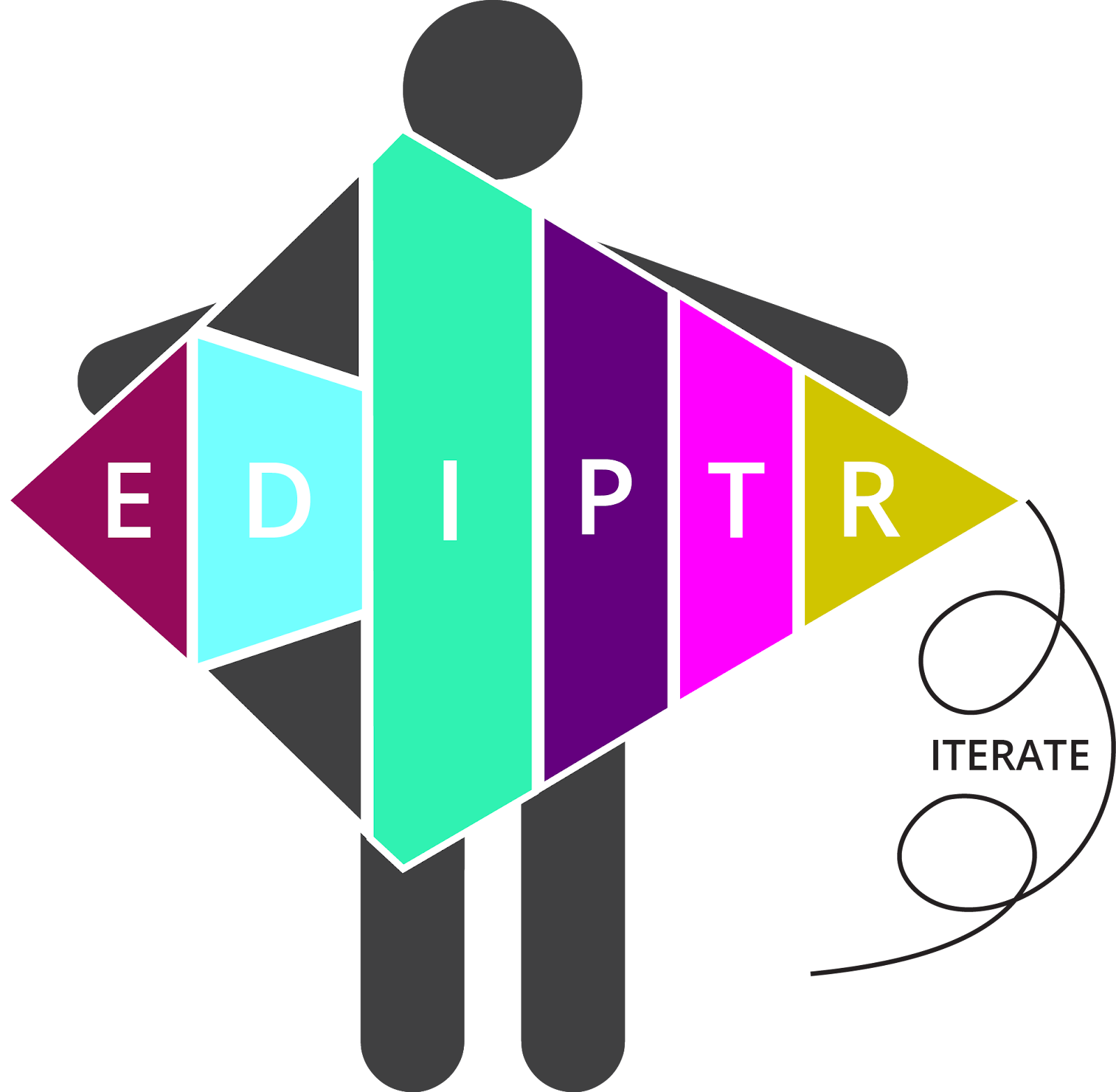
For this task, we used the Mindlab's Kite Design Model. It was a very structured and guided approach which I personally really liked. When sharing concerns or ideas, the listener really had to listen and interpret, what the speaker was saying. I think this is such an important skill and something our students (in fact all people) could benefit a LOT from developing more. But knowing how to listen, and having a real purpose for the listening is also important. Using the design model really helped to enable those skills. I will definitely be using something quite similar in my classroom in the future.


Design thinking by TMLU. The Mind Lab by Unitec Design Thinking Process + materials, which uses our 'kite' model: *Empathise *Define *Ideate *Prototype *Test *Reflect 


We were asked to reflect on the following question: 
How can design thinking be used to enhance students real-world problem-solving skills? 
  • The thing here for me is that students need to have authentic opportunities for applying real-world problem-solving skills in the first place. So this question arises in my mind- is it better to make up problems or create somewhat tenuous situations for students to solve or not to get students to do it at all? I think at least a contrived situation is better and exposes students to problem-solving situations, but also teachers perhaps need to allow students more opportnities to solve their own problems. Keep them local, keep them real, keep them relelvent. Do we always see those opportunities or do we rush in and solve problems for them before the students even realise they are able to solve them themselves.
  • After some authentic problems are identified- then yes ABSOLUTELY design thinking can provide a really structured and supportive framework to help students dig deeper into developing their problem solving ability. I love the empathetic aspect of the Mindlab's Kite design thinking model. The importance of listening to the problem and thinking of different ways to tackle the problem is really stressed in this model. 
  • IDEO's Human Centred Design resonates with me as well:
    • As you move through the human-centered design process, it doesn’t matter what you make, the materials you use, or how beautiful the result is, the goal is always to convey an idea, share it, and learn how to make it better. 
    • The focus is for design to get into the hands of the people who it will serve. Action based
    • Learn from failure- not knowing what the outcome will be- risk-taking
    • Empathise- put yourself in the shoes of the people you are designing for. Immerse yourself in that culture
    • Embrace ambiguity- by not knowing the answers, opening up to creativity and not 'racing' to be the 'first' 
    • Optimism- opening up to tackle those big problems. Embracing opportunities and believing that every problem is solvable
    • Iterate - do things over and over again to improve, create ideas etc
  • I think as human beings we can all develop ourselves through design thinking. Being humble and ready to change for the betterment of the whole world is a noble aspiration. 
  • We can and already do apply design thinking in our own teacher inquiries; for isn't this really just design thinking in action??
The Mindlab by Unitech Design. (nd). Unitech Design Thinking Process. Retrieved from: https://app.themindlab.com/course/release/1313-week-14-digital-design-thinking-in-the-classroom 
IDEO.org. (2015). The Field Guide to Human-Centered Design (1st ed.). Canada: IDEO.org. Retrieved from http://d1r3w4d5z5a88i.cloudfront.net/assets/guide/Field%20Guide%20to%20Human-Centered%20Design_IDEOorg_English-ee47a1ed4b91f3252115b83152828d7e.pdf 

It all Starts Now. Key Change in my Professional Practice.

Coming to the end of my Mindlab journey is bittersweet in many ways. I feel a sense of achievement but also know that this is where I rea...